I’ve always wondered if you can convey a serious message in a graphical way – well here’s my attempt at the need to move away from traditional performance management.

Author: Rob Scott
How to get the best value out of HR systems
originally posted in Inside HR Magazine http://bit.ly/13ocsjj
 There is a correlation between technology and organisational maturity. Source: iStock
There is a direct relationship between organisational maturity levels and the value derived from HR systems, writes Rob Scott
Clients often ask me what the primary influencer is when selecting new HR software, and are generally surprised when I respond that they should first ask their executive management team what they really think of their HR department and what current and future expectations they have of this function.
The executive view is generally very telling, and while there are many factors which influence the selection of HR software – including key business drivers, people focus areas, industry challenges, budget availability and existing vendor relationships – one overriding influencer, and one that is rarely applied sufficiently, is the impact of organisational maturity. Your maturity level is a direct result of how your executive team defines and drives the concept of value (including people value) through the business. It is also the lead indicator of what the HR function will succeed at, and hence the likely value an organisation will get from an investment in HR software.
Your views of people
I like to think about HR software as a mirror. It generally reflects the reality of management’s view of people. In many cases, I see HR departments being blamed for “poor service” and “terrible software” – and while HR incompetency may be a contributing factor, the real issue is often a misalignment of what the HR function does and what the organisation needs in relation to its maturity level.
Some organisations see people primarily as a cost, whereas others see people as a means of producing broad financial and societal returns. While there is no right or wrong position, what your organisation maturity level reveals is the true “expectation” executives have of employees. It also frames any value they would assign to proposed HR initiatives and tools.
According to the Maturity Institute’s framework (ARC) there are nine other “pillars” aside from how people are viewed that when measured together, determine an organisation’s stage of maturity . The “stage” effectively shows the current limit of HR’s value and expectations.
Aligning to maturity levels
When a company has a low level of organisational maturity (e.g. stage 1 or 2), it is unlikely that senior management would regard the HR function as strategically influential, nor see significant benefit in introducing solutions like performance management, career & succession and analytics. In this scenario we often see HR managers using a “stick” approach to drive process compliance with line managers, but few managers actually derive any business value from these HR tools, because the executive team fundamentally don’t see the need to use them to execute their goals. At a maturity level of four or five, there is a completely different expectation of people by executives who understand the importance of these tools to create business value.
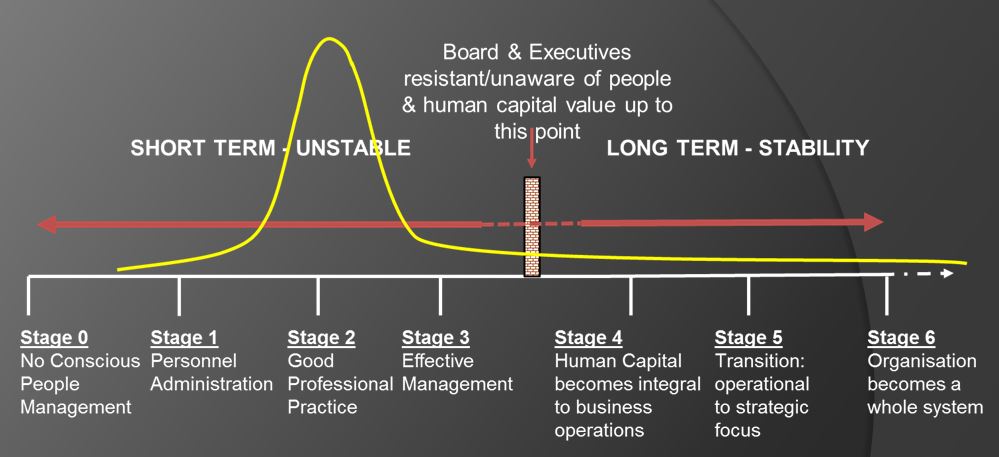
The argument against using maturity for software selection is tied into the “HR best practice” and “best practice technology” belief. Stories of engaged employees, massive cost savings and improved shareholder value are the typical rationale provided by software vendors to buy all their software. I am yet to meet a vendor who is prepared to accept financial accountability if the “best practice” they want you to buy does not work.
Aligning your HR software selection and purchases with your maturity level will give you the greatest opportunity to succeed in HR and build credibility at the executive level. As you improve your maturity level, the need for more strategic and sophisticated HR systems will become obvious and support from executives will easily be attained.
HR systems and organisational maturity
- There is a direct relationship between your organisational maturity level and the value you derive from HR systems.
- HR systems are like a mirror – they reflect how your organisation views people. When people systems are in disarray, it is often a sign of a low organisational maturity level, not poor software or process.
- When HR managers and executives understand and accept what their maturity level means, the role of HR and expectations become clear to both parties.
- Improving your level of organisational maturity is the real catalyst for HR to become a strategic influencer in your company.
Rob Scott is global lead: HR strategy & innovation for Presence of IT, a leading consultancy in HR, talent, payroll and workforce management solutions.
Do Artifacts Have Ethics?
I came across this blog by @FrailestThing and immediately realized the importance of the questions he has raised. They are very thought provoking and challenge your personal and societal views.

Cross Functional Analytics – Unlocking Value
A good blog on the importance of choosing the right source data and understanding what it will achieve for your organisation.

 Like milk and cereal, peanut butter and jam, summer and swimming; sometimes things are better when they are combined. In many cases, the result of a judicious combination can be better than its inherent parts. Even if the components are not clearly related to each other, they can lead to synergies that combine to create something new and in many cases, better.
This is also true in an organisational context where one of the primary reasons for forming a collective, and focussing the energies of many people on a single goal, is precisely that: Many people can achieve far more than individuals could achieve on their own. This compounding of value is also true in analytics and reporting.
While great value can be extracted from the careful analysis of function specific data (Finance, Supply Chain, HR), the benefit and insight obtained from the careful combination of data across these functional…
View original post 516 more words
SaaS HR technology: the new face of HR?
Featured in Inside HR Magazine – October 2014

There is significant value to be derived from HR evolving people practices into a modern digital environment, writes Rob Scott
Compared to traditional on-premise or ERP HR technologies, true SaaS technology has fundamentally shifted the business discussion from one focused on getting HR technology to work effectively to an emphasis on how HR can generate business value through people. While not dismissing the value that many companies continue to derive from traditional on-premise HR solutions, there is no denying the comparatively long and often complex journey traditional HR systems demand in order to achieve the desired outcomes.
Time saving and agility: important ingredients
Executives are realising the long-term impact and financial advantage of effectively managing their people value chain. Together with emerging workplace trends such as remote working, ad hoc team creation, social collaboration, project orientation and hyper-specialisation, the luxury of having time to build solutions to support these new work environments is quickly diminishing.
The workforce itself is changing. It’s a more flexible workforce that is fast becoming a collection of diverse, specialised individuals who have different contractual relationships with a company. And there is an expectation that the tools they use to be productive are simple, yet effective – integrated in a way that supports collaboration and is accessible from anywhere on any device. In a recent survey conducted by Microsoft, 31 per cent of employees said they would be willing to spend their own money on an app if it made them more effective at work.
The last thing an organisation wants is to be held back by software that absorbs a great deal of time and takes even more effort to adapt to the changing demands of the workplace and workforce. The need for agility and swiftness are two critical elements for future business competitiveness, and for these reasons, SaaS HR software is being recognised as a supportive catalyst.
We are moving to a digital work environment rapidly, and mechanisms such as social tools, mobility and gamification are providing the platform for enabling HR to step up to a strategic analytic and evidence-based advisory role. While many ERP tools are bolting on some of this digital capability, the underlying technology and design of these products have not been built with a digital framework. True SaaS HR products have been completely rebuilt from the database objects to the user interface and fundamentally support and integrate with digital design thinking.
HR needs a new set of skills
HR professionals, particularly those from a social sciences background, have generally been reluctant to build personal skills and knowledge in technology. In many respects, this has limited their ability to be effective in driving traditional HR technology projects. New SaaS tools have largely solved this problem because of the simplicity in how these tools are set up and maintained. SaaS tools have fewer configuration and modification options than ERP solutions, which in my mind is a good thing for HR. Too often, ERP tools are redesigned at great cost but with little business benefit.
I believe there are other complementary areas where HR functions can build competency and expertise. First, social intelligence – understanding how social thinking is introduced into business and HR strategies and enabled through digital technology. Second, analytic intelligence – making sense of lots of new people-related data that will be created as the digital work environment evolves. This includes data from wearable technology and from everyday objects that are connecting to the internet (internet of things). Analytic intelligence will have a strong predictive focus rather than a reactive statistical slant.
The next three years open up a window of opportunity for HR to evolve people practices into a modern digital environment. There is significant value to be derived, and HR must now become self-sufficient in making this a reality.
Key SaaS trends for HR
- True SaaS HR software is quite different from ERP products. When you pull back the covers, the underlying design is geared to support a digital HR environment.
- Modern organisations no longer have the luxury of extended time to redesign their HR solutions – SaaS tools offer agility and simplicity.
- Now is the time for HR professionals to take ownership of HR software projects with no need to be intimidated by a lack of IT knowledge.
- News skills for HR in social and analytic intelligence are critical to understand how software will create people value.
Rob Scott is global lead: HR strategy & innovation for Presence of IT, a leading consultancy in HR, talent, payroll and workforce management solutions.
The future of HR data ownership
Article I wrote for Inside HR Magazine in June 2014

http://www.insidehr.com.au/the-future-of-hr-data-ownership/
Your Future HR System is an Open Data Platform
 Let me start this blog off by drawing a comparison between Banking and the Travel Industry. Think about how you interact with your Bank digitally. You can do general banking at an ATM, on-line or through a smart phone app, you may use applets which help you calculate loan repayments or the future value of your deposits. But that’s where it generally ends. Try applying for a Mortgage and suddenly you’re confronted will loads of paper, duplication of information, signatures in black ink, proving your credit worthiness, physically going into the bank, multiple approval layers and reviews and possibly a lengthy waiting period until you have an answer.
Now think about the travel industry ~ your ability to build a personalized flight itinerary, buy insurance, book a hotel and car, check what others think about your choices, selectively introduce influencing factors such as price, time and loyalty points, get progress alerts and much more ~ all done without much fuss and no people interaction. You can choose which website or apps to use rather than being confined to the actual service provider and even use your smart phone as the mechanism to store and scan your electronic boarding pass. The only time you engage with a person is at the security check and boarding gate. This is a mature digitized industry, and arguably a higher risk one than Banking.
If we compare current main-stream HR/Talent software (including SaaS) to these two industries, most would agree that they are more like the Bank scenario. On the positive side vendors are including functions such as ESS, Social Recruiting and On-line Learning which are empowering users and streamlining processes, but there are some fundamental changes required for HR to achieve equivalent digital maturity, implied efficiency, fantastic end-user experience with choice as that of the travel industry.
Here are some of the key elements that would need to change.
1. Modernize the Database Layer
The relational database management system (RDBMS) has been the cornerstone of transactional processing and reporting in HR systems for over 25 years. The need for this type of structured storage remains, but as we see new data types such as graphic, recognition, video, voice, gesture and style (eg. what I click on) being generated for work purposes, the RDBMS is not the optimal solution. There is a requirement to introduce non-SQL type databases which are able to leverage and manage the data inherent in these new data types. Non-SQL databases would allow HR to move beyond a fairly rigid and logical-based limitation (think workflow) and introduce personalized services, offerings and actions based on your unique data and interactions.
2. Standardization to Individualization
Much of the constraint in HR efficiency is inherent in the need to control and dictate a process that supports the HR software rather than focusing on the outcome. We have spent years telling managers that standardization is critical, but in reality we limit the availability of choice in HR processes because of software constraints and by implication to make HR’s life more manageable. HR vendors needs to move past this hurdle and allow users to achieve the same outcome, but through an individualized approach. The underlying data remains the same, but the “How” becomes a choice. (Think about your choices when booking an airline ticket).
3. A Dynamic Data Hub rather than the Source of Truth
We are seeing some HR solutions starting to venture down this path with interfaces or search capability to LinkedIn, Facebook and other 3rd party tools. The type of data that will be important to HR in the future will be generated outside of the core HR system by individual employees, contingent workers and applicants. We need HR solutions that can integrate to potentially thousands of external and individual databases to share information. The future Workforce will ultimately give employers the right to use their data whilst they are employed and will expect data generated during employment to be shared back to the originating database. The notion of the HR system being the source of truth for people data is outdated and is constraining innovation and creativity.
4. The HR System becomes a Platform
Removing the need to use the vendors HR software or front-end in order to access data or perform actions will allow for greater integration and ownership by line managers and employees. Much of the frustration experienced by line managers is the need to go into “another” tool to execute an HR activity or get information to support a decision. In a similar way that Expedia.com piggy-backs off the data and system of the individual airlines, hotels and car renters, HR systems should allow for direct transactions through other tools (this is not the same as interfacing). A platform approach will allow for greater flexibility and agility at the company and individual level, and will give rise to continuous improvements in other systems (finance, procurement, workforce planning etc.) to use HR data to achieve a common end result. As an example, think of how a project manager could use his project planning tool to provide performance feedback rather than going into the HR tool itself or the scheduling manager at a consultancy could “pre-approve” leave for employees “on the Bench” from his WFM software.
Many of the new HR cloud and SaaS software products are fantastic solutions, but fundamentally they have not changed for over 25 years. I implemented my first networked HR system in 1987, and while we had no smartphone apps, high speed internet or fancy front-ends, most of the modules we have today, existed in those older system.
We are stuck in a logic and transactional mind-set and as we witness the emergence of powerful new data types, it’s time to break these shackles and build software that will allow HR to surge ahead. If a high risk industry such as Travel can achieve this, there is no reason that HR can’t do the same.

Desire and Capability – Aligning the desire for HR analytics to BI Capability
Well thought through article !

Being able to measure its own performance is critical to the HR function. One of the key challenges facing HR is its ability to track and measure those aspects of itself that truly add value to the organisation. Understanding this and the varying degrees of maturity in the process, are essential to designing an appropriate HR analytics approach.
Feedback is critical
Feedback is essential to the survival of any complex organism. The human body has multitudes of feedback mechanisms to provide the brain with key information about the current state of the individual; pain, pressure, heat, proprioception, balance, sight, hearing etc. are all systems that incorporate different sensing networks that provide the brain with immense volumes of data. The brain then analyses this input to determine how well the body is progressing towards any one of a number of goals. The ability to understand and apply this incoming information, as…
View original post 1,156 more words
The rise of the SMATE
Photo Credit – amanda.murphy4 – Flickr
There are times in our recent history where particular events have epitomized the turning-point in global views, perceptions and behaviors ~ like the fall of the Berlin Wall and the end of the “Cold War”, the release of Nelson Mandela and the end of Apartheid, 9-11 and the rise of terrorism, 2008 and the Global Financial Crisis. These events cause “global ripples” and while many people are impacted directly, there are many more people that feel the change in indirect ways. For HR, a turning-point has been Cloud & SaaS solutions, taking center stage in late 2012 – the direct impact is on HR departments from an empowerment perspective, but the real value impact is achieving organisational goals through people.
HR Cloud and SaaS solutions are fundamentally shifting and empowering the HR environment, putting HR in a renewed position to influence organisational objectives and create value through people. But these new solutions are vastly different from the typical ERP products that dominated for decades, and the individuals who became the “life-savers” or “Stars” for those projects were just that because of their experience and insight into managing complex technology tools. They were the technical experts who dominated workshops and discussions to figure out how to set up the HR solution technically.
The latest cloud and SaaS solutions require significantly less technical prowess, and with this we see the client conversation shifting from “how to best configure the software ?” to a more HR flavored discussion of “how do I create value through people ?”. This shift in discussion from technical to people may be easily overlooked, but is more fundamental and deserves greater consideration than perhaps one may think.
HR leaders are starting to take genuine ownership of cloud HR system projects because they are now able to have discussions which are not being dominated by the technology questions (which were all very important by the way) nor left feeling inadequate to contribute in workshops that were driven by the “Technology Stars” using a language and approach which was foreign to them. In HR Cloud and SaaS projects, HR owners will rightly have a different expectation of the project language, approach and outcomes. Cloud and SaaS has lifted the technology complexity for HR and this will spur them on to want to discuss the HR “How” rather than the Technology “How” – the big question is who is best positioned to lead this new discussion with HR….enter the SMATE.
This new discussion with clients and team members will require someone quite unique – an HR SMATE, or an HR Subject Matter & Technology Expert. Many current HR system consultants may be inclined to assume they are a SMATE by virtue of their closeness to HR technology, but the reality is that a true SMATE is a bit like hens teeth – pretty rare at the moment! While many technology educated people have worked in HR systems for years, their point of reference for HR and best practice is mostly framed by the HR technology they know so well – their discussions with an HR professional has been fairly process and system oriented, and most HR professionals will quickly pick up the lack of depth in HR expertise. Likewise many HR people have a mindset about technology that doesn’t go far beyond the UI (user interface) and get lost in discussions on architecture, object management, databases and interfacing. This is frustrating for technology people who understand the critical nature of these discussions to the solution outcome.
HR ERP implementations primarily needed to lead with a technology mind-set ~ the individuals could learn HR/Talent processes to support discussions. It hasn’t however been easy to motivate an HR trained person to learn technology at a level that would enable adequate discussion across coding, configuration and architecture. But cloud and SaaS HR solutions changed that with technical requirements becoming more system set-up (We however still need hardcore techies for integration and custom developments). In a very short period of time HR professionals can learn the ins-and-outs of a cloud tool set-up and confidently introduce these requirements into an HR discussion, The tide has turned and it is easier for an HR professional to become a true SMATE than for a technology oriented person to do so.
We need true SMATE’s to rise up and become the catalyst for new system discussions with HR executives and project owners. To become the driver behind HR/Talent systems delivering value beyond transactional activity. SMATE’s will engage in deep-dive conversations around people behavior and social science thinking in the same way technology people drove technical discussions during ERP projects. Where this happens, we will see greater HR successes.
The organizations and consulting firms that nurture HR SMATE’s will be putting themselves in a strong position to create true HR value and help HR functions become a significant contributor to their organisational goal achievement – the true HR SMATE is the next HR system “star”
Do HR Systems Need A Sexy UI?
 My Scottish heritage drives me to blurt out “Och Aye!” ( meaning oh yes) on this one ~ why shouldn’t our HR systems with all their new-found business support enjoy the best presentation on our desktops, tablets and smartphones? There are so many creative advancements taking place in the UI ( user interface or more accurately, human-machine interaction) world that it is easy to be charmed by their mystique and the experience they take you through ~ but while the demos might look great, we need to consider the practicalities of using these tools on top of what (in many cases, but not all) are essentially HR solutions with a traditional data model design. Naomi Bloom has been a lone voice for a while on the realities of trying to make an old HR technology architecture perform new tricks, versus the benefits of a system designed for purpose. It’s the classic “Lipstick on the Pig” scenario when you introduce modern UI principles on top of an old back-end.
Take for example “kinetics”, the tools that emerged to support gaming consoles like the Wii and Xbox. It basically detects your body movement and converts your movement into system commands. So how practical or effective would this be for an HR product? – probably not at all is my guess given that HR systems are not fundamentally designed to leverage that form of input and neither is it practical to capture text in that way. A technology company in Lithuania offers a kinetic interface for online banking solutions, well all I can say is it hilarious to watch the actor swinging their arms around to transfer money from one account to another. Can you imagine a new employee casually walking past an in-progress performance assessment using the new HR kinetics ESS tool – the arm-swinging manager and employee may send him scuttling to find a new employer.
The big buzz word in UI design is “Experience” and it’s driven by the multitude of consumer applications that are leveraging everything from Voice, Gesture, Eye-tracking, Multiple-touch, Movement, and more to create a memorable and different ways to capture and deliver information or results. Golden Krishna a senior UI designer from Samsung is promoting the “No Interface” approach, which will learn about your preferences and create an interface that is unique to your style. We are already seeing some of this thinking emerging in Google predictive products (Like Google Now). The advancements in this space are increasing at a rate of knots, to the extent that it is unlikely that HR business application vendors can keep up as part of their normal product development cycle – they will need to decouple the UI capability from the remaining solution architecture elements.
So while many HR systems are stuck with their traditional data models, the useful and feasible UI enhancements, particularly those on mobile applications, should focus on turning the HR data into embedded analytics and decision making support as well as greater portability of the HR business processes. There is a lot more that HR vendors can do to make these elements a greater user experience with richer functionality and content without the need to leverage the latest UI gimmicks.
HR Vendors who have built their products with a user process mindset (rather than a data model) will have greater short term opportunity, especially in the ability to directly interact with employees, to leverage newer UI developments. But while it is tempting to vigorously exploit these, vendors must ensure they don’t inadvertently create new complexities in HR systems which reduce usage and start corridor sniggering.
 Fade to black